

Lectio Divina
Lectio Divina for kids: read, wonder, pray, and rest
Try Lectio Divina with kids using a ten-minute, age-aware family rhythm, child-friendly questions, short passages, and a free printable guide.
- Detail
- 6-page PDF
- Detail
- Print friendly
- Detail
- Free · no email
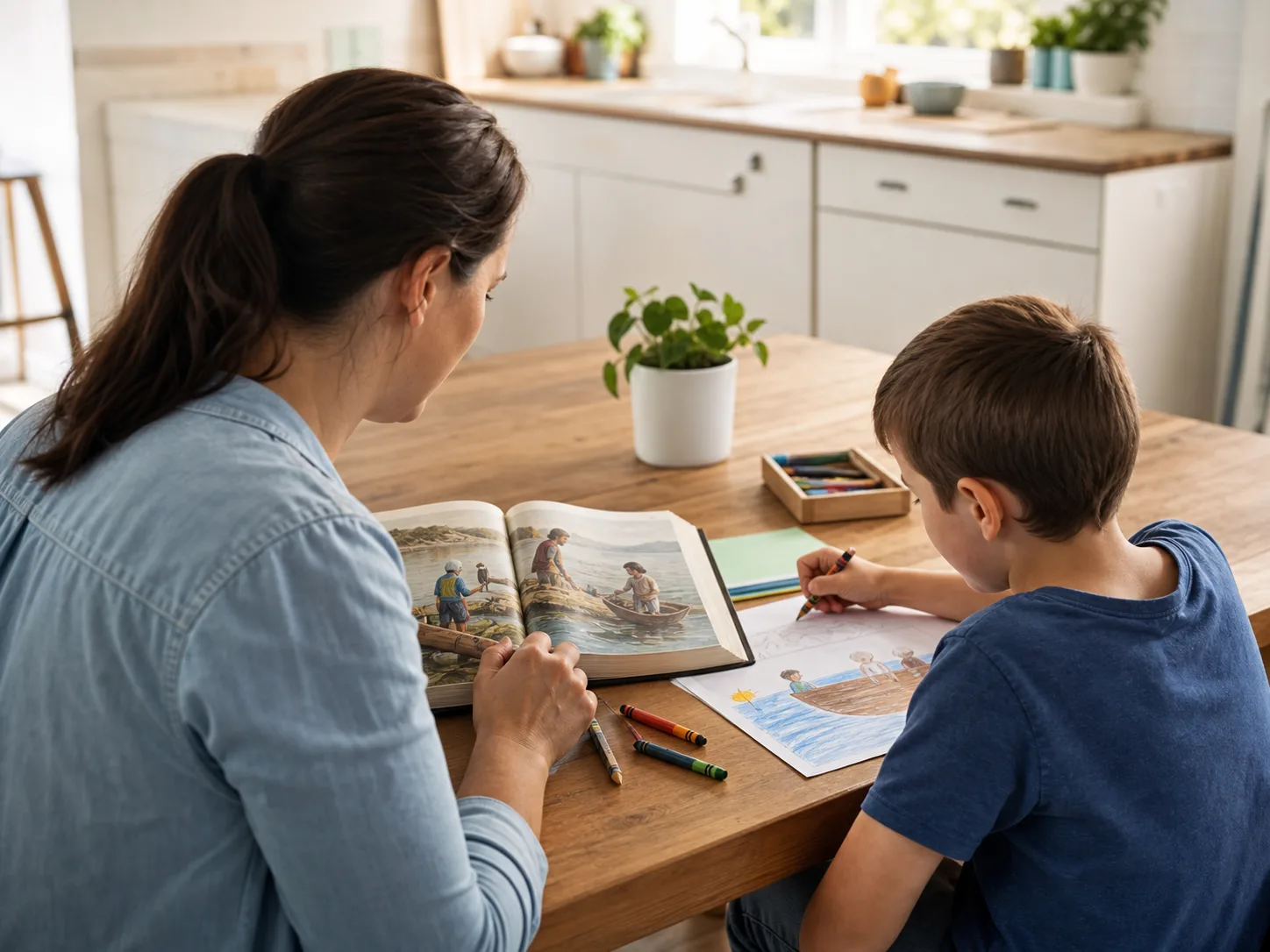
Here is a ten-minute Lectio Divina you can lead with children tonight: read, wonder, pray, rest, do — five child-friendly movements with the actual words to say at each one. It works best when adults shorten the practice, welcome interruptions, and let a child’s real observation come before the adult explanation. Print the table card if you would rather hold it than remember it. This is an invitation to listen together, never a test of quietness or spiritual performance.
Family prayer
A ten-minute family rhythm
Run sheet
10 minutes total
- 01
Welcome
1 min
“You may sit, draw quietly, hold something, or simply listen. No one has to share.”
- 02
Read
2 min
“Listen for one word, picture, action, or question that catches your attention.”
- 03
Wonder
3 min
“What did you notice, and what might this part show us about God or Jesus?”
- 04
Pray
2 min
“You may say one sentence to God, repeat a line from the story, draw, or pass.”
- 05
Rest and do
2 min
“Let’s be quiet for a few breaths, then choose one phrase or small response to carry.”
Choose a passage a child can hold
Use a complete scene or short saying with a concrete image: Jesus blessing children, the lost sheep, the mustard seed, Zacchaeus in the tree, Mary at Jesus’ feet, or Psalm 23. Read from a translation the child can understand. For young children, tell or read a story under five minutes. Older children can follow a paragraph in their own Bible.
Preview the passage so you can explain one necessary word without turning the gathering into a lesson. Lectio is not a substitute for teaching, but this moment gives attention before explanation. Ask, “What did you notice?” and allow an answer such as a color, action, feeling, or question. That concrete notice is already a beginning.
- Ages four to seven: use a short story and one question.
- Ages eight to eleven: read twice and invite a word or image.
- Ages twelve and up: add quiet journaling and a context question.
- End while attention remains; shorter can be more faithful.
Read and wonder without correcting the moment
Read once for the whole story. After a small pause, ask who is present and what happens. Read again and invite everyone, adults included, to name one word, picture, or action that stood out. If a child interrupts with a question about the text, receive it as attention rather than automatically treating it as misbehavior.
During wonder, use open questions: “What does this show us about Jesus?” “How do you think the person felt?” “What part would you like to hear again?” If an answer is inaccurate, return gently to the words: “Let’s see what the story says.” Save a longer theological explanation for afterward so the child does not learn that prayer means guessing the adult’s preferred answer.
Pray in words a child can own
Invite one sentence to God based on the passage. A child may say thank you, help, sorry, please, or nothing aloud. Offer a simple stem: “Jesus, thank you for…,” “God, help me…,” or “I wonder about….” Adults should pray briefly too, modeling ordinary honesty rather than a miniature sermon.
Never require a child to disclose fear, conflict, or family information in order to participate. Let them pass, draw, or repeat a line from the passage. If a serious concern emerges, respond with care after the practice and involve the appropriate parent, pastor, safeguarding lead, counselor, or professional rather than using the group prayer to investigate.
Rest without making stillness a behavior chart
Contemplative rest for a child may be thirty seconds, not ten minutes. Use a gentle visual cue such as turning over a small sand timer, holding an open hand, or listening for the quietest sound in the room. Say, “We can be quiet with God, and you can keep your eyes open.” Movement, fidgeting, and looking around do not automatically mean the child is not praying.
If silence increases anxiety or dysregulation, skip it. Read the carry phrase together, draw the story, or take a quiet walk instead. The purpose is not to train compliance. It is to make room for attention, relationship, and response in a way that respects the child in front of you.
Do one small thing the passage invites
Ask, “What could we remember or do?” Keep the response specific and communal when possible: include someone at lunch, thank a caregiver, place a worry in a prayer jar, feed birds, visit a neighbor, or reread the story at bedtime. Avoid making every passage into a moral assignment; sometimes the response is simply receiving that God is near.
Return to the carry phrase later without quizzing. A parent might say, “I remembered ‘Jesus welcomed them’ when I felt rushed.” This shows that adults also need Scripture and that practice continues imperfectly through the day. Celebrate noticing rather than correctness or streaks.
A ready ten-minute family script
Welcome everyone: “We’re going to listen to a short Bible story. You may sit, draw quietly, or hold something in your hands.” Read Mark 10:13–16. Ask what each person noticed. Read the key sentence again: “Allow the little children to come to me.” Wonder what Jesus is like in the scene. Invite a one-sentence prayer or a pass.
Keep thirty seconds of quiet or drawing. Then ask what phrase the family wants to remember. Close: “Jesus, thank you that children are welcome near you. Help our home make room for people with patience and joy. Amen.” The next time, reuse the same structure with a different short passage. Familiarity lets attention deepen.
Sources and further reading
- USCCB Lectio Divina introduction
A historical and practical overview of prayerful Scripture reading and its traditional movements.
- Notre Dame Campus Ministry guide
A concise guide to reading, meditation, prayer, contemplation, and action.
- World English Bible
The public-domain source used for short Scripture excerpts and the passages selected for the printables.
- Teaching Catholic Kids Lectio guide
Age-aware examples for introducing prayerful Scripture reading to children and families.
Frequently asked questions
- What age can a child begin Lectio Divina?
- Young children can begin with a very short Bible story, one noticing question, and one sentence of prayer. Increase reading, silence, and journaling gradually with age and interest.
- What if my child will not sit still?
- Let them draw, hold a quiet object, stand, or keep their eyes open. Shorten the practice and measure engagement by attention to the story, not by a motionless posture.
- Should I correct a child’s answer?
- Return gently to the text when needed, but do not turn every observation into a quiz. Receive what they noticed first and save extended teaching for a separate moment.
- Can a church or school use the printable?
- Yes, for ordinary family, classroom, or small-group use. Keep sharing optional and follow your organization’s safeguarding policies when a child raises a concern.