

Christian meditation
Christian meditation vs. Eastern meditation: comparing beliefs without flattening traditions
Compare Christian meditation with several Eastern meditation traditions carefully: shared outward practices, different beliefs, aims, and authorities.
- Detail
- Complete guide
- Detail
- Free to read
- Detail
- No signup
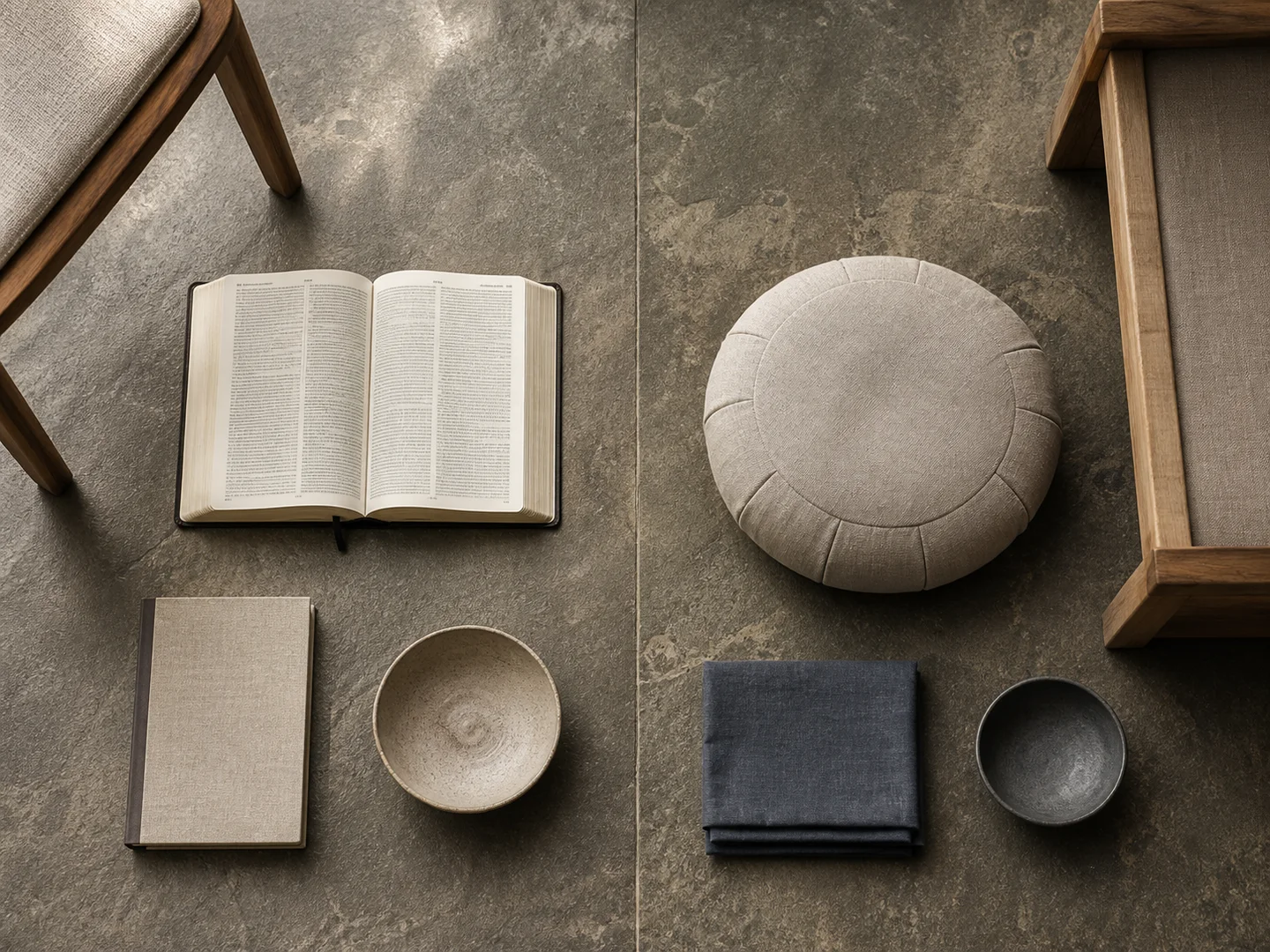
‘Christian meditation vs. Eastern meditation’ sounds like a simple comparison, but the category ‘Eastern meditation’ contains many traditions that disagree with one another. A fair guide names specific examples. This page compares Christian Scripture meditation with Theravada insight meditation, Zen meditation, and the classical Yoga of Patanjali. It notes shared outward disciplines—attention, repetition, posture, silence—while keeping their different authorities, views of self, diagnoses of the human problem, and spiritual goals visible.
Beliefs and aims
Compare named meditation traditions
Eastern traditions are diverse. This table compares named examples and broad orientations; it does not define every school or practitioner.
Scroll to compare →
| Dimension | Christian Scripture meditation | Theravada insight meditation | Zen meditation | Classical Yoga |
|---|---|---|---|---|
| Primary frame | Scripture, Christ, prayer, and church | Buddhist path and early Theravada teachings | Mahayana teaching, lineage, and communal practice | Yoga Sutras and varied Hindu interpretation |
| Common object | Biblical text, God, Christ, or prayer | Body, feeling, mind, phenomena, or concentration object | Seated awareness, breath, koan, or just sitting | Concentration object, mantra, or disciplined awareness |
| View of self | Created person called into communion | Insight into not-self and conditioned processes | Nondual insight framed through emptiness and Buddha-nature traditions | Purusha distinguished from prakriti in classical Yoga |
| Human problem | Sin, alienation, disordered love, and death | Suffering sustained by craving and ignorance | Ignorance, attachment, and deluded separation | Misidentification and mental fluctuation |
| Spiritual aim | Communion with God and Christlike love by grace | Liberation from suffering and clinging | Awakening expressed in compassionate life | Liberation or isolation of purusha |
| Place of technique | A servant of prayer; not a mechanism that produces grace | Part of an ethical, contemplative path | Embodied discipline within a school and lineage | One part of an eight-limbed discipline |
Begin with traditions, not stereotypes
Buddhism, Hindu traditions, Jainism, Sikhism, Daoism, and modern secular mindfulness cannot be treated as one religion. Even within Buddhism, Theravada, Zen, Pure Land, Tibetan, and other schools frame meditation differently. ‘Yoga’ may refer to modern postural exercise, a broad family of Hindu disciplines, or the particular philosophical system associated with the Yoga Sutras. Any clean two-column chart hides this diversity.
Christian traditions also differ. Lectio Divina, imaginative Gospel prayer, the Jesus Prayer, silent contemplation, and Protestant Scripture meditation are not interchangeable, even though they share a Christian frame. The comparison table therefore uses narrow labels and broad orientation only. It is an entry point for understanding, not a verdict on every practitioner or school.
What outward practices can look similar
Practitioners across traditions may sit still, regulate attention, repeat a word, observe distraction, use breath as a stabilizing cue, or practice in community. These similarities are real and worth describing without fear. Human bodies and minds have limited ways to become quiet and attentive, so shared techniques do not prove that traditions teach the same thing—or that borrowing is automatically neutral.
A repeated phrase illustrates the point. A Christian may repeat the Jesus Prayer as address and petition within relationship to Christ. A Buddhist recitation may recollect the Buddha or support concentration within a different account of liberation. A yogic mantra may function within yet another metaphysical and devotional system. The sound may repeat; its authority, reference, and intended transformation differ.
Christian Scripture meditation
Christian Scripture meditation receives the Bible within the worship and teaching of the church, attends to what a text says, responds to the triune God, and seeks a life conformed to Christ in love. The self is neither ultimate nor erased; it is created, accountable, wounded, loved, and called into communion with God and neighbor. Salvation is gift and relationship, not a mental state produced by technique.
Christian apophatic traditions can use language of silence, unknowing, detachment, or self-emptying. Those terms should not be assumed to mean precisely what emptiness or no-self means in a Buddhist context. Christian contemplatives remain oriented to the Creator-creature distinction, incarnation, grace, and love of God and neighbor even when prayer becomes wordless.
Theravada insight and Zen meditation
Theravada insight practices are commonly situated within the Buddhist path and investigate impermanence, unsatisfactoriness, and not-self. Concentration and mindfulness support insight into conditioned experience and liberation from clinging. Modern programs may extract selected methods into secular wellness settings, but that adaptation is not identical to the full religious path.
Zen traditions emphasize seated meditation within Mahayana Buddhist communities, teachings, ethics, and lineages. Different schools understand shikantaza, koan practice, awakening, ritual, and teacher relationship in distinct ways. Describing Zen as merely ‘emptying the mind’ is inaccurate; disciplined awareness and insight occur within a rich account of practice and realization.
Classical Yoga and modern postural yoga
The Yoga Sutras present an eight-limbed path including ethical disciplines, posture, breath regulation, withdrawal, concentration, meditation, and absorption, oriented toward liberation. Interpretations of self, God, devotion, and practice vary across Hindu philosophical and devotional traditions. Modern studio yoga often foregrounds posture and health and may retain, reinterpret, or omit religious elements.
Christians therefore make different prudential judgments about using a posture, breath cue, or class. A physical technique does not automatically transfer an entire worldview, yet context and intention matter. Ask what is being taught, invoked, promised, and practiced rather than deciding from a label alone. Respect also means not renaming another tradition's full spiritual path as secretly Christian.
How to learn across traditions without pretending sameness
Begin by listening to knowledgeable practitioners describe their own tradition. Name the exact practice, its source, and its intended goal. Distinguish respectful learning from claiming that all paths teach the same hidden truth. Similar experiences do not settle theological questions, and strong disagreement does not require caricature or contempt.
For Christian practice, keep Scripture, Christ, prayer, community, and love central. If a borrowed method confuses conscience or displaces those anchors, choose another. If it simply helps you sit without pain or notice distraction, evaluate it plainly rather than mystifying it. The goal is informed faithfulness with honest respect for neighbors, not anxiety or easy synthesis.
Sources and further reading
- On Some Aspects of Christian Meditation
A historic Vatican document locating Christian prayer in Christ, the Holy Spirit, grace, discernment, and embodied love.
- Prayer with Sacred Scripture
A concise teaching on reading faithfully, receiving the Spirit's help, testing subjective interpretation, and expressing prayer in charity.
- World English Bible
A public-domain English Bible for checking the cited passages in their full context.
- Stanford Encyclopedia of Philosophy: Buddha
A scholarly overview of early Buddhist teaching, practice, suffering, not-self, and liberation.
- Internet Encyclopedia of Philosophy: Yoga
A scholarly introduction to the Yoga Sutras, eight limbs, concentration, meditation, and liberation.
Frequently asked questions
- Is Christian meditation just mindfulness with Bible verses?
- No. Attention skills may overlap, but Christian meditation is prayer oriented to God through Scripture and Christ, within a theological and communal frame.
- Do Eastern traditions all try to empty the mind?
- No. That phrase flattens diverse Buddhist, Hindu, and other practices. Many cultivate disciplined attention, insight, compassion, devotion, or concentration within distinct teachings and goals.
- Can Christians use breathing or posture?
- Breathing and posture are human capacities. Consider the specific context, teaching, intention, and effect rather than assuming a technique is spiritually neutral or automatically incompatible.
- Are all meditation experiences ultimately the same?
- Similar descriptions do not erase different interpretations and aims. Traditions can share human experiences while disagreeing about God, self, suffering, liberation, grace, and authority.